
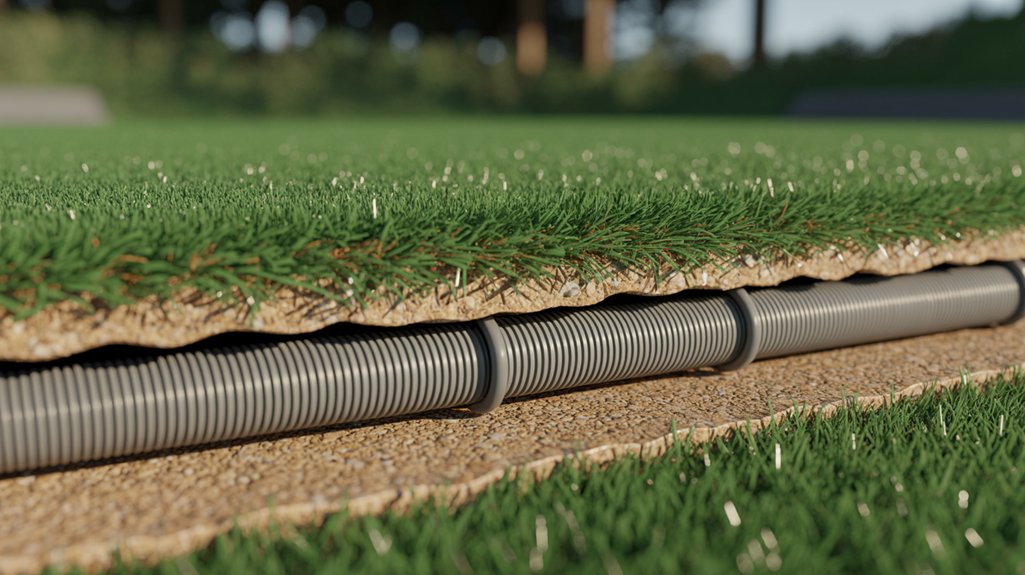

Conduit Can Run Beneath Artificial Turf, Governed by NEC Burial and Listing Rules
Conduit can run beneath artificial turf, with the installation governed by NEC rules on voltage class, conductor type, burial depth, and mandatory protection at penetration points rather than left to installer discretion. Requirements vary by whether the run sits under a driveway, roadway, or standard landscape area, since burial depth thresholds differ accordingly. Conduit is the protective raceway housing conductors beneath the turf and aggregate base.
Low-Voltage Systems and NEC Article 411
NEC Article 411 governs low-voltage landscape lighting systems operating at 30 volts or less, a category that includes path lights, in-ground uplights, and accent strips installed beneath artificial turf. Under this article, the entire system must be listed, must not exceed 30 volts between conductors, and must draw power from a listed Class 2 power supply or transformer. Conductors buried beneath the turf and aggregate base must carry a direct-burial rating — Type UF cable or another listed low-voltage cable rated for the specific installation condition — rather than relying on standard indoor-rated wiring. This distinction matters because Class 2 circuits, while operating at reduced voltage, still require the same attention to cable listing and burial suitability as higher-voltage systems, and noncompliance can void manufacturer warranties or fail inspection.
Burial Depth Under NEC Table 300.5
NEC Table 300.5 sets the minimum cover for listed Class 2 low-voltage cable at 6 inches, measured from the top of the conductor to finished grade rather than to the bottom of the trench. That baseline applies to typical residential landscape runs beneath turf and aggregate base, but the table specifies deeper cover in higher-traffic locations: 18 inches under one- and two-family dwelling driveways, and 24 inches under streets, highways, roads, alleys, and parking lots. These increased depths reflect the greater risk of mechanical damage from vehicle loads and excavation activity in those areas. Table 300.5’s notes also permit a lesser depth where the listed lighting system’s own installation instructions specify one, meaning the applicable figure for a given run is not automatically the table’s default value and should be verified against manufacturer documentation before installation.
Where Conduit Protection Becomes Mandatory
NEC Article 300 requires that direct-burial conductors be protected by rigid or listed conduit at every penetration point and at any location subject to mechanical damage, rather than left exposed beneath the turf and aggregate base. Penetration points — where conductors emerge from below-grade routing to connect to a fixture, junction box, or power supply — represent the highest-risk changeover zones, since the cable is no longer shielded by continuous soil and base material. Locations subject to mechanical damage include areas beneath foot traffic concentration points, edging interfaces, and anywhere aeration, spiking, or infill grooming equipment could contact the run. In these zones, conduit is not a design preference but a code-mandated protection measure, and installers must size and route it before the aggregate base is compacted.
Splices Require Listed Weatherproof Enclosures
NEC Articles 300 and 411 require that any splice or connection in a below-turf conductor run be housed in a listed weatherproof or direct-burial-rated junction enclosure, regardless of the system’s voltage class. A splice left exposed or wrapped beneath the aggregate base and turf backing does not meet this standard, even on a 12-volt landscape lighting circuit, because moisture intrusion and soil contact create long-term corrosion and short-circuit risk at the connection point. The enclosure must be rated for continuous burial contact rather than merely weather-resistant, since incidental splash exposure and constant subsurface moisture present different failure conditions. Installers should locate splice enclosures at accessible points where future maintenance will not require cutting into compacted base material or lifting turf infill.
Bonding and Wet-Location Listing Requirements
NEC Article 410 requires every luminaire installed within or adjacent to artificial turf to carry a wet-location listing, since the combination of irrigation, condensation, and subsurface moisture in the turf base exposes fixtures to conditions ordinary dry-location listings do not address. This listing requirement applies regardless of whether the fixture operates on line voltage or a Class 2 low-voltage circuit under Article 411. Separately, NEC Article 250 requires bonding of any metallic luminaire component that contacts the turf backing or aggregate substrate, addressing the risk that a metal housing or stake in constant soil contact could become energized through insulation failure or corrosion. Together, these provisions treat below-turf lighting as a wet-location electrical environment rather than an extension of typical dry landscape wiring, and installers who substitute damp-location fixtures or skip bonding on metallic components create a code violation even when the visible installation appears complete.
Coordinating Conduit Routing With Subbase Drainage
NEC Article 300 requires that conduit routing beneath artificial turf be coordinated with subsurface drainage design, since the aggregate base and turf backing sit directly above the conduit run and both systems compete for the same subbase pathways. A conduit run installed along a line that would otherwise serve as a lateral drainage channel toward a perimeter collection point can obstruct water movement, leading to standing moisture beneath the turf system. This conflict is far easier to resolve during design, when conduit placement and drainage slope can be planned together, than after the aggregate base has been compacted and the turf installed. Installers who sequence conduit trenching without consulting the drainage plan risk having to re-excavate a compacted base, disturbing both the electrical protection and the drainage grade established under the turf assembly.
Frequently Asked Questions
Questions about conduit beneath artificial turf tend to cluster around the same practical concerns: cable type, burial depth, splice protection, and the interaction between conduit and drainage design. Each answer traces back to a specific code provision rather than general practice, since NEC Articles 300, 411, and Table 300.5 dictate the actual thresholds rather than leaving them to installer preference. The following responses address these recurring questions directly, with reference to the conditions that determine which rule applies.
What type of cable is required for conduit beneath artificial turf?
Direct-burial rated cable, such as Type UF or another listed low-voltage cable, is required beneath artificial turf. This requirement applies specifically to conductors covered under NEC Article 411 for systems operating at 30 volts or less. Conduit protection remains mandatory at penetration points and mechanical-damage locations, regardless of cable rating.
How deep does electrical conduit need to be buried under turf?
Minimum cover for listed Class 2 low-voltage conductors is 6 inches, measured from finished grade to the top of the conductor. Depth requirements rise to 18 inches under residential driveways and 24 inches under streets or parking lots. Manufacturer installation instructions can permit shallower burial than Table 300.5 specifies.
Do splices under artificial turf need special enclosures?
Yes, splices beneath artificial turf require listed weatherproof or direct-burial rated junction enclosures under NEC Articles 300 and 411. This applies regardless of voltage class, including low-voltage landscape lighting circuits. An unprotected splice buried under turf fails code compliance, risking corrosion, short circuits, or inspection failure.
Does conduit placement affect turf drainage design?
Yes, conduit placement can conflict with turf drainage design. Conduit routed along paths intended for lateral drainage flow toward perimeter collection points can obstruct water movement beneath the aggregate base. Coordinating conduit routing with drainage design early avoids conflicts that become difficult to resolve after base compaction.
Serving Colorado Springs CO with Artificial Grass Installation
The Broadmoor, Kissing Camels, and the Cedar Heights foothills corridor share sloped terrain and expansive lot depths that push drainage and low-voltage lighting runs beneath turf systems well beyond typical suburban distances. Our conduit and Article 411 lighting installations are designed for these exact conditions, coordinating burial depth, junction placement, and drainage routing before base compaction begins rather than after. Consultation is available by appointment for property owners evaluating turf and lighting scope across these corridors. Properly routed conduit and code-compliant low-voltage systems protect the turf installation as a long-term asset, translating into recovered functional square footage rather than a recurring repair expense. Beyond the Broadmoor and Cedar Heights, the firm extends this same conduit and drainage-coordinated approach to properties throughout the greater Colorado Springs region, including Black Forest and Monument, where soil composition and slope present comparable installation demands.