
Colorado Springs’ Altitude and Freeze-Thaw Cycling Change Several Design Choices
Colorado Springs’ altitude and frequent freeze-thaw cycling do change several turf design choices. UV exposure roughly 12 percent above sea level accelerates fiber degradation, while 124 annual freeze-thaw cycles drive subbase settlement and edge lift, requiring stronger UV stabilizers, capillary-break aggregate layers, and tighter anchor spacing. Artificial turf is synthetic grass installed over a compacted base for landscaping use.
Elevation and UV Exposure Accelerate Fiber Degradation
Ultraviolet radiation intensifies by approximately 2 percent for every 1,000 feet of elevation gained, placing Colorado Springs’ city center roughly 12 percent above sea-level UV exposure, with neighborhoods above 7,000 feet experiencing even higher levels. Combined with nearly 300 sunny days annually, this elevated UV load accelerates the photo-oxidative breakdown that governs synthetic turf fiber lifespan. Color fading, chalking, and fiber embrittlement occur faster at these elevations than at comparable sea-level installations, shortening the effective service life of undersuited products. As a result, specifying fiber built with a robust hindered-amine-light-stabilizer package carries more weight in this market than in lower-elevation, lower-UV regions, where minimally stabilized budget turf may perform adequately.
124 Annual Freeze-Thaw Cycles and What They Stress
The Colorado Springs Airport weather station, per NOAA climate normals, records an average of 124 freeze-thaw cycles annually, among the highest figures documented for any major urban area in the continental United States. This frequency results from intense midday solar radiation at altitude warming exposed surfaces above freezing even in winter months, only for nighttime temperatures to fall back below freezing after sunset. Repeated daily cycling of this kind stresses artificial turf systems in two specific ways: localized subbase settlement from expansion and contraction of moisture trapped in the aggregate base, and perimeter edge lift as freeze-thaw movement works against the turf’s anchoring nails. Both failure modes are directly tied to cycling frequency rather than to absolute winter temperature minimums, distinguishing Colorado Springs from colder but less thermally volatile climates.
Preventive Subbase and Anchoring Responses to Freeze-Thaw
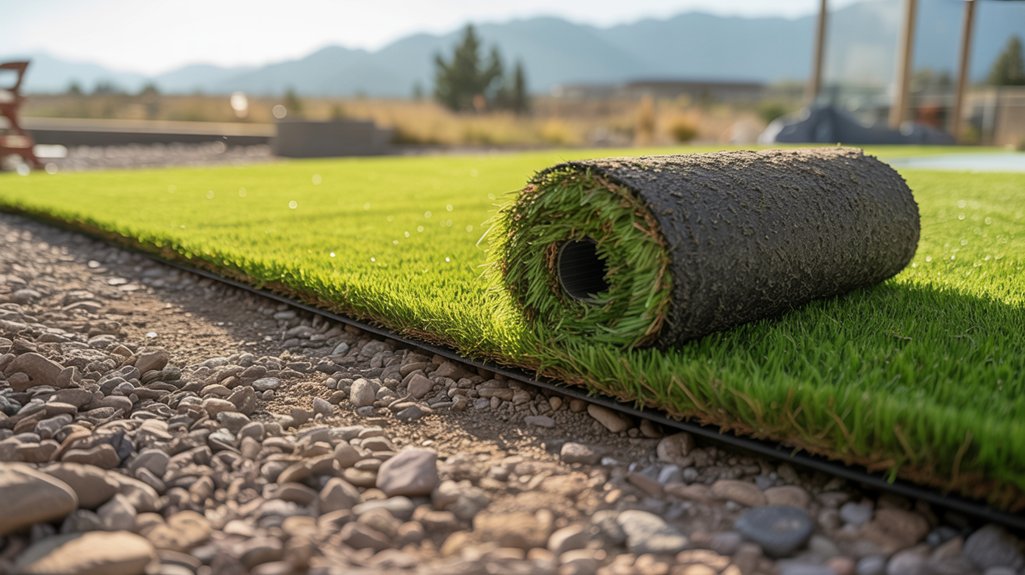
A capillary-break layer of clean, coarse aggregate placed between a frost-susceptible subgrade and the base course is the standard preventive response to Colorado Springs’ 124 annual freeze-thaw cycles. This layer interrupts the wicking of moisture upward into the base material, reducing the expansion and contraction that otherwise produces localized subbase settlement over repeated cycling. At the perimeter, installers commonly specify tighter anchor spacing than a baseline lowland installation would call for, since freeze-thaw movement works directly against the turf’s anchoring nails and can loosen edges over successive seasons. Together, these two responses address the subbase and edge-lift failure modes tied specifically to cycling frequency rather than to absolute winter temperature minimums, distinguishing design choices in this market from those in colder but thermally stable climates.
The 30-Inch PPRBD Footing Depth Versus the 38-Inch NOAA Figure
The Pikes Peak Regional Building Code, the authority having jurisdiction for the City of Colorado Springs and El Paso County, requires a 30-inch footing depth for frost consideration. This figure is a code mandate, not a climatological estimate, and it governs structural elements such as fence posts, pergola footings, or edging piers rather than the turf surface itself. A separate 38-inch figure sometimes cited in regional planning documents derives from NOAA’s 50-year meteorological recurrence data and reflects a statistical frost-depth projection rather than an enforceable code minimum. Confusing the two can lead installers or homeowners to over-specify or under-specify footing depth on ancillary structures. Standard grade-level turf installation, absent an attached structural component, typically falls outside this requirement entirely.
Semi-Arid Climate Reduces One Failure Mode, Stresses Another
Colorado Springs receives approximately 16 inches of annual precipitation, and summer afternoon humidity commonly falls below 20 to 25 percent, conditions that work against one common turf failure mode while intensifying another.
Algae and moss colonization in turf infill typically require sustained moisture and shade, so the region’s semi-arid climate suppresses this failure mode relative to humid-climate installations, all else equal. However, the same dryness and intense solar exposure that limit biological growth place added stress on organic and wood-based edging materials. Wood bender board, in particular, is prone to drying, checking, and loosened fasteners under these conditions, since low ambient humidity accelerates moisture loss from untreated or minimally treated wood. This trade-off means a single climate variable improves one aspect of long-term turf performance while creating a distinct maintenance liability elsewhere in the installation, a dynamic that shapes edging material selection discussed next.
Edging Material Selection in a Low-Humidity Climate
Composite edging and concrete curbing resist the drying, checking, and fastener loosening that summer afternoon humidity below 20 to 25 percent commonly induces in untreated wood bender board across Colorado Springs installations. Because low ambient moisture accelerates cracking in organic materials, manufacturers of composite edging formulate products with UV-stabilized polymer blends that do not depend on retained moisture content for dimensional stability. Concrete curbing offers a similar advantage: it is inert to humidity swings and unaffected by the freeze-thaw movement that works against anchoring nails at turf perimeters. Wood bender board remains viable only where installers apply sealants rated for repeated moisture-loss cycling, adding a maintenance obligation that composite and concrete alternatives avoid in this specific climate profile.
Frequently Asked Questions
Homeowners considering artificial turf in Colorado Springs tend to circle back to the same handful of questions once altitude, freeze-thaw cycling, and permitting enter the conversation. Some concerns, like UV degradation and frost movement, carry real consequences for fiber selection and base preparation. Others, like permitting requirements and algae growth, turn out to be less complicated than the region’s climate reputation might suggest.
Does high altitude affect how long artificial turf lasts in Colorado Springs?
Yes, high altitude shortens artificial turf lifespan in Colorado Springs. UV exposure runs roughly 12 percent above sea level at city-center elevation, accelerating fiber fading, chalking, and embrittlement. Specifying turf with a robust hindered-amine-light-stabilizer package matters more here than in lower-elevation markets.
Why does freeze-thaw cycling matter for artificial turf installation?
Freeze-thaw cycling causes repeated expansion and contraction in the subbase and at turf edges, leading to settlement and edge lift. Colorado Springs averages 124 annual freeze-thaw cycles, among the highest in the country. A capillary-break aggregate layer and tighter perimeter anchor spacing address this risk.
Does artificial turf installation require a permit in Colorado Springs?
Standard grade-level residential turf installation does not require a permit in most Colorado Springs jurisdictions. This applies specifically to flat turf areas without accompanying structures. Attached elements like edging piers, fence footings, or pergolas fall under Pikes Peak Regional Building Code’s 30-inch depth requirement.
Is algae growth a concern for artificial turf in a dry climate?
Algae growth is not a major concern for artificial turf in Colorado Springs’ semi-arid climate. Roughly 16 inches of annual precipitation and summer humidity often below 20-25 percent limit the moist, shaded conditions algae need. Drought stress instead targets wood-based edging, favoring composite or concrete alternatives.
Artificial Grass Installation Across Colorado Springs CO
Colorado Springs’ turf performance is governed by altitude-driven UV intensity, an average of 124 annual freeze-thaw cycles, and the 30-inch footing depth standard under the Pikes Peak Regional Building Code for any structural elements installed alongside it. We work within these engineering realities daily, applying hindered-amine-light-stabilized fiber selection, capillary-break base layering, and perimeter anchoring adjusted for freeze-thaw movement as standard practice on every artificial grass installation across the region. Consultations are available by appointment for property owners in Colorado Springs, Monument, and surrounding El Paso County communities weighing turf against the ongoing costs of irrigation, mowing, and reseeding. Framed against long-term maintenance and resale considerations, a properly engineered installation functions as durable, low-upkeep square footage rather than a discretionary expense. Our approach reflects an understanding that this market’s conditions demand more from base preparation and material selection than lower-elevation, less climatically demanding installations typically require.