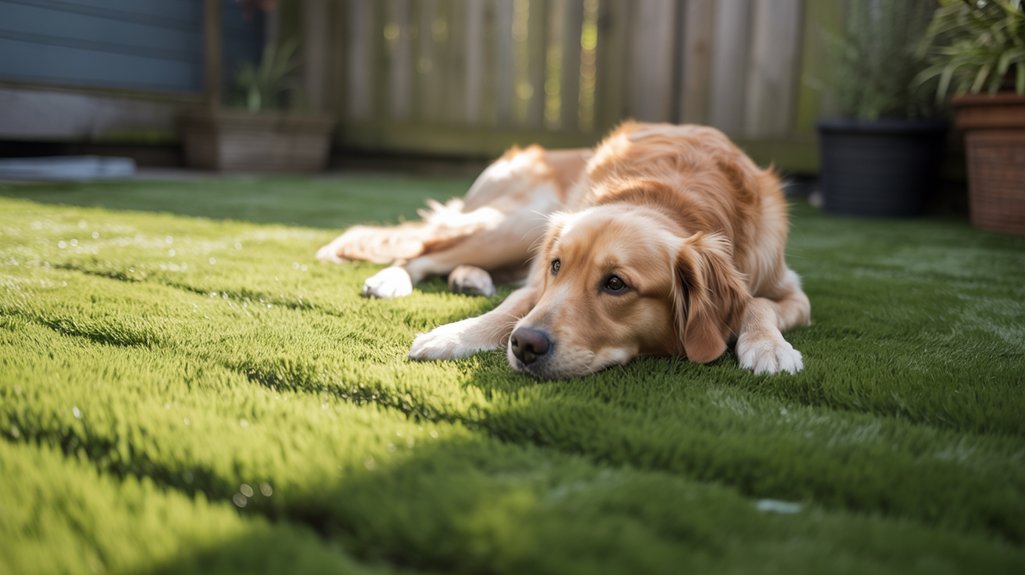
Artificial Grass Works for Pets When the System Is Built for Pet Use
Artificial grass works for pets when drainage, backing, and base depth are engineered for concentrated urine rather than general foot traffic. Polyurethane backing with ample drainage perforations, a nonwoven geotextile layer, and a 6-to-8-inch aggregate base prevent odor-causing bacterial hydrolysis of urea. Pet-use artificial grass is a synthetic turf system built to rapidly carry liquid waste away from the surface.
Why Pet Waste Drives the Design of the Whole System
Dog urine concentrates on a small surface area of turf, and the resulting bacterial hydrolysis of urea into ammonia is the primary mechanism behind chronic odor in pet installations. This single fact dictates nearly every design decision in a pet-use artificial grass system, since drainage speed determines whether waste liquid clears the backing before volatilization occurs. Uric acid, a secondary byproduct, crystallizes on fibers and backing as liquid evaporates, resisting plain water rinsing and giving bacteria a surface on which to multiply. Because of this, a pet system is judged first on how fast it moves liquid through the pile, the perforated backing, the aggregate base, and into the subgrade, rather than on appearance or texture. Every subsequent material and depth choice follows from solving that drainage problem.
How Urine Becomes Odor: Hydrolysis and Uric Acid Crystallization
Bacterial hydrolysis converts urea into ammonia within hours of contact with turf backing, which is the chemical reaction responsible for the sharp odor associated with poorly drained pet turf systems. This process accelerates in warm weather, as higher temperatures increase bacterial activity and promote faster volatilization of ammonia gas into the surrounding air. Uric acid, a secondary byproduct of urine breakdown, does not dissolve readily in water and instead crystallizes onto turf fibers and backing material as liquid evaporates from the surface. These crystals resist removal through routine water rinsing alone, creating a persistent substrate that harbors odor-causing bacteria and compounds. Left unaddressed, this buildup compounds over time, meaning each subsequent urination event contributes to a growing reservoir of crystallized residue rather than being fully cleared from the system.
Backing Chemistry and Pet Use: Polyurethane Versus SBR Latex
Polyurethane secondary backing does not absorb water, a property that distinguishes it from styrene-butadiene rubber (SBR) latex backing commonly used in older or lower-grade turf systems. Because polyurethane remains non-porous, liquid waste and dissolved uric acid pass through drainage perforations rather than soaking into the backing material itself, which limits the accumulation of odor-causing residue over repeated use. SBR latex, by contrast, can absorb and retain moisture along with crystallized urine byproducts, creating conditions favorable to bacterial colonization within the backing structure. This retained moisture has been associated with earlier material breakdown in turf subjected to heavy, concentrated pet traffic, making backing chemistry a functional consideration rather than a cosmetic one. For installations expected to handle regular dog urination, polyurethane backing addresses the root mechanism of chronic odor more directly than latex-based alternatives, since it removes a reservoir where hydrolysis and crystallization would otherwise continue unchecked between cleanings.
Attribute
Polyurethane (PU)
SBR latex
Water absorption
Does not absorb water
Absorbs moisture more readily than PU
Pet urine residue
Reduces the tendency for odor-causing compounds to accumulate in the backing
Can absorb and retain moisture and crystallized urine residue, contributing to chronic odor
Tuft bind (ASTM D1335)
Higher values than SBR latex at equivalent or lower coating weights
Adequate at the weights specified in most residential product standards
UV stability
Generally more resistant to UV degradation
Less UV-stable; becomes brittle and prone to micro-cracking after prolonged exposure
Dimensional stability
Lower thermal expansion and contraction
Can expand on hot days and contract in cold, causing buckling or wrinkling
Performance in heavy pet use
Associated with longer service life expectations
Shows tuft bind reduction and backing degradation earlier in the service life curve
Cost
Higher material and processing cost
Lower cost; dominant in cost-sensitive residential turf
Polyurethane versus SBR latex secondary backing for pet-use turf
Aggregate Base Depth for Dog Runs and Pet-Relief Areas
Aggregate base depth for pet-relief zones commonly runs 6 to 8 inches, compared with the 3 to 4 inches typical of standard residential turf installations. This added depth increases both the structural capacity of the base to withstand concentrated foot traffic and the volumetric capacity for liquid to pass through before pooling at the surface. A deeper aggregate layer, typically composed of crushed stone or decomposed granite, allows urine to move downward through the drainage perforations and base material faster than hydrolysis can proceed, which is the chemical reaction responsible for ammonia odor. Beneath the aggregate, a nonwoven geotextile separation layer prevents fines from migrating upward and clogging pore space, preserving long-term percolation rates in zones where dogs repeatedly urinate on the same section of turf.
Maintenance Habits That Keep Pet Turf Fresh
Rinsing artificial turf within minutes after a dog urinates interrupts the bacterial hydrolysis of urea before ammonia volatilizes into the surrounding air. Because this conversion process is time-dependent, prompt removal of liquid waste from the pile and backing is more effective at controlling odor than any after-the-fact cleaning product. Hose rinsing with plain water flushes dissolved urea through the drainage perforations and aggregate base before uric acid crystals have a chance to form on fibers, since uric acid’s low solubility makes it resistant to removal once it dries. Enclosed or poorly ventilated installations require more frequent rinsing because still air allows ammonia concentrations to build faster than in open yards. Periodic deeper cleaning with enzymatic solutions targets residual uric acid crystals that routine rinsing alone cannot dissolve, breaking down the compound that plain water leaves behind.
Residential Pet Turf Versus Commercial Animal Facilities
No federal statute or CPSC/EPA rule designates a separate regulatory category for residential pet-use artificial turf, leaving system design rather than product labeling as the determining factor in suitability. A single-family backyard, dog run, or pet-relief area falls outside the health-department sanitation permits and stormwater management requirements that govern commercial animal facilities such as boarding kennels and municipal dog parks. Those commercial sites answer to inspectors and permit renewals, which forces measurable drainage and sanitation performance; a residential installation answers only to the owner’s tolerance for odor. Consequently, a backyard system can be under-built for heavy pet use without triggering any violation, since aggregate depth, backing material, and drainage rate remain discretionary choices rather than code-mandated specifications in the residential context.
Frequently Asked Questions
Pet owners considering artificial grass tend to ask the same handful of questions, and most trace back to drainage, odor, and depth rather than the material itself. Whether urine clears the system depends on perforation density and base composition working together, not on the turf alone; odor, in turn, results from waste dwelling long enough for bacterial hydrolysis to occur, which a well-drained installation prevents. Base depth and regulatory status round out the remaining concerns, since concentrated pet use demands structural capacity that ordinary landscape turf doesn’t require, even as residential installations remain largely free of the sanitation rules governing commercial animal facilities.
Does pet urine drain through artificial grass?
Yes, pet urine drains through perforations in the secondary backing into the aggregate base below. Drainage speed depends on perforation density, base depth, and backing material, since polyurethane resists moisture retention better than SBR latex. Prompt rinsing after use prevents ammonia buildup and uric acid crystallization.
Can artificial grass cause odor in a dog run?
Yes, artificial grass can cause odor in a dog run when drainage is too slow to clear urine before bacterial hydrolysis occurs. Uric acid crystals resist plain water rinsing and let odor-causing bacteria persist on fibers and backing. Deeper aggregate base and prompt rinsing minimize ammonia buildup.
Is a deeper base needed for a pet-relief area?
Yes, pet-relief areas need a deeper aggregate base than standard landscape installs. A 6- to 8-inch depth is commonly specified to handle concentrated urine volume and support faster drainage. This extra depth reduces ammonia buildup from hydrolyzed urea and limits uric acid crystallization in backing.
Do pet installations face different regulations than ordinary turf?
No, residential pet installations are not subject to distinct federal or state regulations beyond general turf chemical-safety rules. Suitability depends on system design—drainage, backing material, and base depth—rather than any regulatory label. Commercial facilities like kennels or dog parks, however, do face added health-department and stormwater requirements.
Backyard Paradiso Artificial Grass Installation Across Its Service Areas
Concentrated urine load, variable regional heat that accelerates ammonia volatilization, and subgrade soil profiles with inconsistent percolation all govern whether a pet turf system drains fast enough to prevent bacterial hydrolysis before it becomes chronic odor. Backyard Paradiso has built its pet-relief and backyard installations around these drainage realities, specifying aggregate base depth and perforation layouts suited to each site rather than applying a single standard approach to artificial grass for pets. Consultations are available by appointment for property owners evaluating backing material, base depth, and maintenance requirements before committing to an installation. Properly engineered drainage systems are better framed as functional square footage that holds up under daily pet use and supports resale value than as a simple material purchase. The firm’s work spans established markets across its service area, where soil conditions and climate patterns vary enough that a drainage specification suited to one neighborhood may underperform in another. That variability is why the engineering comes first and the finished look follows from it.