
Turf Can Be Installed Around Mature Trees, but Root Systems Change the Design
Yes, artificial turf can be installed around mature trees, but the root system requires adjusted excavation depth, hand-digging near the root zone, and a mulch or hardscape buffer at the trunk. This matters most where feeder roots occupy the upper soil profile and continue growing after installation. Artificial turf is a synthetic landscaping surface installed over prepared subgrade and aggregate base.
Excavation Depth Within the Root Zone
Standard artificial turf installation requires stripping 4 to 6 inches of organic topsoil and placing 4 to 8 inches of compacted aggregate base beneath the carpet, a depth range that overlaps directly with the upper soil profile where a mature tree’s fine feeder roots concentrate. Excavating to full standard depth within a tree’s root zone risks severing enough of these roots to stress or destabilize the tree. For that reason, installers typically reduce excavation depth near the trunk and hand-dig rather than mechanically trench within the root zone, preserving more of the existing root structure. The aggregate base is also held to a thinner section immediately adjacent to the tree, producing a less uniform subbase that demands more deliberate compaction verification during installation.
Root Pressure Is a Documented Long-Term Edge-Lift Cause
Turf industry failure-mode documentation identifies root pressure from adjacent trees as a recognized, independent cause of perimeter edge lift, distinct from freeze-thaw cycling or thermal expansion of the backing material. As a mature tree’s root system continues expanding after installation, growing roots can physically displace anchoring nails or stakes along the turf perimeter, gradually working the edge loose from the subgrade. This is not a defect traceable to installation error but an ongoing structural interaction between living root tissue and a fixed synthetic edge. Because the tree continues growing for the entire service life of the turf, edge lift from root pressure is a recurring maintenance consideration rather than a risk that resolves once installation is complete. Periodic inspection of the perimeter nearest the trunk and root flare is warranted to catch displacement before it propagates along the seam.
Keeping the Turf Edge Clear of Trunk Growth
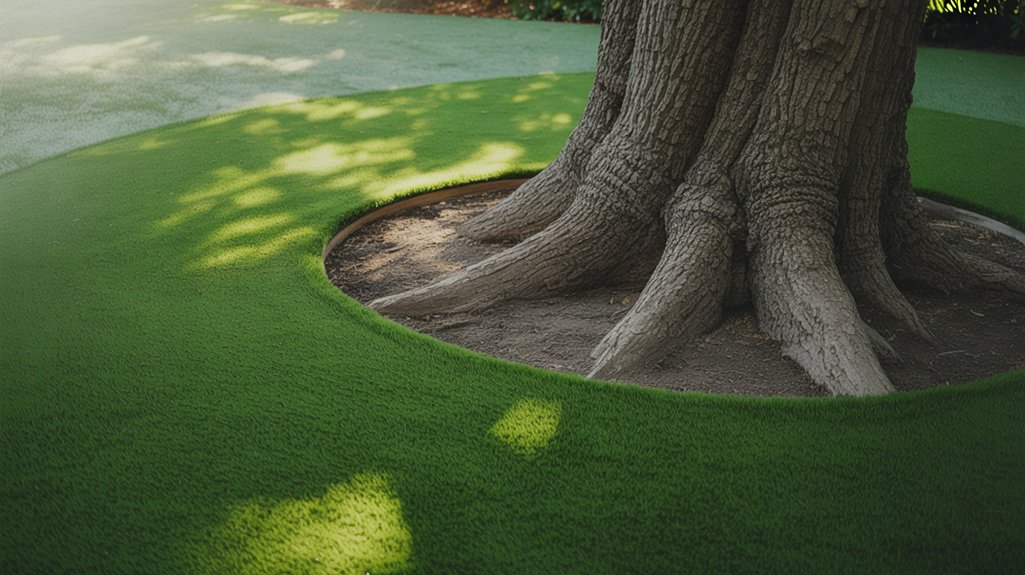
A hardscape or mulch ring installed at the base of a mature tree’s trunk, sized to accommodate expected trunk-flare growth over the turf system’s service life, is the standard method for keeping synthetic turf clear of the zone where root and trunk expansion are most active. This buffer prevents the aggregate base and turf backing from being installed tight against the bark, an approach that fails once the trunk continues its natural diameter growth against a fixed, unyielding edge. Sizing the ring requires anticipating multi-year expansion rather than accommodating only the tree’s current diameter, since retrofitting the buffer after installation is more disruptive than planning for it upfront. The ring’s radius should be re-evaluated periodically alongside the perimeter inspections already warranted by root-pressure edge lift.
Why Bark Contact With Turf Backing Is a Concern
Sustained bark moisture against a tree trunk creates conditions favorable to fungal cankers and bark decay, a risk documented in arboricultural guidance from the International Society of Arboriculture regarding mulch and hardscape installations near trunk flares. Synthetic turf backing, typically a polyurethane or latex-coated polypropylene layer, is designed to retain moisture within its perforations to support infill drainage, which is precisely the opposite of the dry, breathable condition healthy bark requires. When turf backing is installed flush against a trunk, water intercepted by the canopy or irrigation can wick into the bark-turf interface and remain trapped for extended periods rather than evaporating. Over successive seasons, this sustained-moisture condition can compromise the tree’s vascular cambium at the point of contact, independent of any mechanical damage caused by root or trunk-flare growth against the turf edge.
Drainage Design Beneath Tree Canopy
Dense tree canopy can reduce direct solar exposure at ground level by 80 percent or more, a shading effect that extends the duration of surface moisture retention after rainfall or irrigation cycles, according to arboricultural shade-density studies referenced in landscape drainage guidance. This prolonged dampness is the same environmental condition the synthetic turf industry identifies as conducive to algae and moss colonization within pile fibers and infill material. Because canopy shading cannot be altered as part of a turf installation, drainage design must instead compensate through the hardscape components themselves. Specifying higher backing perforation density and a subbase aggregate layer with greater void ratio and permeability beneath canopy-shaded zones allows water to clear the root zone faster than the surrounding soil profile would otherwise permit. Installers working in these zones should treat drainage capacity as a fixed design requirement rather than a variable dependent on typical full-sun assumptions used elsewhere on the same site.
Hand-Digging Versus Mechanical Trenching Near Roots
ISA (International Society of Arboriculture) root-protection guidance identifies mechanical trenching within a mature tree’s critical root zone as capable of severing 25 percent or more of a tree’s fine feeder roots in a single pass, a loss threshold associated with measurable canopy decline. Hand excavation avoids this risk because it allows the installer to navigate around individual roots larger than an inch in diameter rather than shearing through them indiscriminately. Within the root protection zone, industry practice calls for hand-digging as the default method, reserving mechanical trenchers for areas clearly outside the tree’s root spread. This distinction affects both installation timeline and subgrade uniformity, since hand-dug sections beneath a mature canopy require more labor hours and produce a less consistent excavation depth than machine-trenched ground. Compaction verification becomes correspondingly more important in these irregular zones.
Frequently Asked Questions
Questions about installing turf near mature trees tend to cluster around the same concerns: root damage, trunk clearance, moisture-driven growth like algae, and the risk of future lifting at the edges. Each issue traces back to the same underlying tension between a static installed surface and a root system that keeps growing and responding to its environment. The answers below address these points directly, with attention to the specific conditions that make each risk more or less significant on a given site.
Will installing turf near a tree damage its roots?
Standard excavation can damage a mature tree‘s roots if installers strip soil and compact base material at typical depths near the trunk. Feeder roots concentrate in the upper soil profile, so shallower, hand-dug excavation near the root zone reduces severed roots. This makes uniform compaction verification more critical in that thinner subbase area.
How close can artificial turf be installed to a tree trunk?
Turf should stop short of the trunk, leaving a mulch or hardscape ring rather than butting aggregate base and backing directly against bark. This buffer must be sized for expected trunk-flare growth over the turf’s service life. Otherwise, expanding trunk and roots distort the edge while trapped moisture against bark harms the tree.
Does tree canopy shade increase the risk of algae in artificial turf?
Yes, tree canopy shade increases algae and moss risk in artificial turf. Reduced sunlight keeps the pile and infill damp longer after rain or irrigation compared to full-sun areas. Shaded zones beneath canopy warrant higher backing perforation density and stronger subbase drainage capacity.
Can tree roots lift artificial turf after installation?
Yes, tree roots can lift artificial turf after installation. This occurs as ongoing root growth displaces anchoring nails or pushes up the perimeter, independent of freeze-thaw causes. A trunk-flare-sized mulch or hardscape ring keeps edges clear of active root expansion.
Artificial Grass Installation in Colorado Springs CO
Reduced excavation depth within a tree’s root protection zone, hand-digging in lieu of mechanical trenching near feeder roots, and backing perforation density adequate to shaded-canopy drainage conditions are among the technical thresholds governing artificial turf installation around mature trees. We applies this understanding of root-zone excavation limits, trunk-clearance ring sizing, and canopy-driven drainage demands to its artificial turf installations across the Colorado Springs area. Consultations are available by appointment for properties where mature trees factor into design and subgrade planning. Properly executed installations of this kind protect the tree’s long-term health while preserving the turf as durable, low-maintenance square footage that holds its value over the life of the landscape rather than requiring early replacement or repair. This approach serves clients throughout Colorado Springs, Monument, and Woodland Park, where mature tree canopy is a common feature of established residential lots. Grounding in these root-zone and drainage considerations reflects a broader commitment to installations built to withstand the specific conditions of each site, not generic specifications applied without regard to what already exists on the property.